Today was one of those “Groundhog Travel-Days”; where you wake up, spend a day travelling, go to sleep, cross the International Date-Line, and you’re back to the same day again… very discombobulating.
We awoke to partially overcast skies… a good-thing as our plan was to have breakfast, finish packing, check out, and spend a last few hours down at one of the pools. Breakfast, as usual, was good; although the clouds rolled in a little and the air began to feel close. We managed to compress, jostle, mash, and otherwise physically cram all of our stuff into our luggage… we started the trip with a backpack and a day-pack each… now, somehow that has grown to include another piece of checked luggage and two more carry-ons. It was a good thing that Cathay Pacific’s checked luggage allowance was old-school generous. With the help of a bellhop and one of their shuttle-trucks, we were able to get everything down to the luggage storage area without herniating anything or any one… our additional checked bag was rather deceiving; it was only a small, non-descript duffle-bag but it was packed to bursting with pounds and pounds of spices and two large stone mortar and pestles.
After storing our gear, the bellhop graciously offered to drive us back up to the pool; an offer that was gratefully accepted. On the short drive, a light rain began to fall… it might have been raining, but it was still around 34 Degrees Celsius (about 93 Degrees Fahrenheit) and steamy-humid.
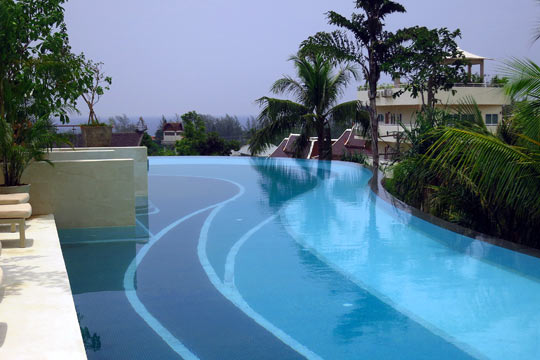
Infinity Pool; still pretty nice even in a light rain.

Our last couple of hours at the pool. Eron squinting as the sun broke through the clouds.
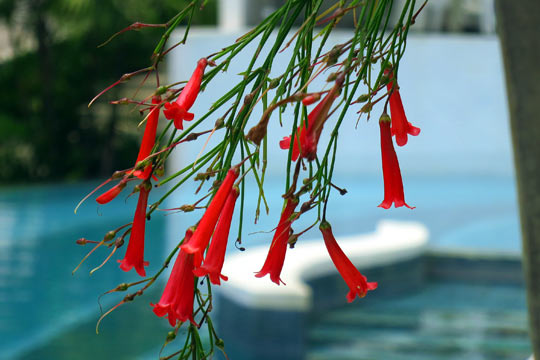
Contrast in colours; pool-side flowers.
Some of our constant-companions at the pool were a bunch of beautiful Dragonflies. They are a stunning vermillion and they flew in intricate patterns above the water sometimes landing on the edge of the pool to rest.

Vermillion Dragonflies.
Unfortunately, by 1:30 PM, we had to look at getting changed to go to the airport. Luckily for us, The Mandarava was well set up for taking care of “checked-out guests”. The restrooms around the corner from reception are equipped with very nice shower stalls… they even brought fresh bath towels, hand towels, and soap to us. The only downside, and this is not a complaint, is that the restrooms are not air conditioned. It was so humid that as we tried to dry off after the showers; we couldn’t actually towel-off fast enough to keep up with the fresh perspiration! After that, it was the final goodbyes and farewells – especially with the bellhops; they really took good care of us during our stay.
The ride to Phuket International Airport (http://en.wikipedia.org/wiki/Phuket_International_Airport) normally takes about 1 hour and 15 minutes. Although our driver warned us it may take a bit longer as the main highway was being up-graded and therefore we would be driving through Patong City. The drive was uneventful and we arrived at HKT with plenty of time to spare. Check-in was a breeze, as was going through security screening, and we were in the secure passenger area with time to find lunch… this was a problem only so much as in the secure area there are no “sit-down” dining facilities, only a number of fast-food outlets and coffee places. So, there are places to find something quick to eat, just don’t plan on getting a restaurant-type sit-down meal. Right on time (or pretty close, anyhow – “TIT”), we boarded our flight to Hong Kong.
The flight to Hong Kong was about four hours and we landed at just after 11 PM local time. We definitely need to give kudos where kudos are due and HKG (http://en.wikipedia.org/wiki/Hong_Kong_Airport) deserves credit for very efficient and smooth handling of transiting passengers. We hit the terminal at just after 11 PM; even with time for a potty-break, we were through security screening and wandering around in a duty-free store near our gate by 11:25 PM! When in Hong Kong, one must pay your tithe to the gods of consumerism… and we did our share – what’s another carry-on… only one more plane ride. We board Cathay Pacific CX888 to Vancouver at just past midnight. So, it’s now April 11, 2014. The flight, even though the Captain warned us about possible turbulence over the North Pacific, was relatively smooth. The flight attendants served us “dinner”, which was surprisingly decent, and people started drifting off to sleep soon afterwards… us included.
I awoke to find that sometime during the night we had crossed the International Date-Line and it was now April 10, 2014… again. I was awake for good so what to do… even in Economy Class, the Cathay Pacific Boeing 777 ER’s have very decent seatback-mounted entertainment centres with a plethora of audio and video choices. However, as I’m known for saying, “I’ve spent a lot of time, energy, and money on getting and mounting ever bigger and better television screens and AV systems, why would I want to watch movies on those itty bitty screens”; usually in reference to tablets, phones, and notebooks but in this case, it also applies to the seatback video screens. I just didn’t feel like watching any of the available movies or TV shows… but, there was also an option for a selection of games. So now, not only am I a blogger, I’m also (as of last evening) the Flt CX888 reigning points-champion of “Solitaire”… yes , you may now bow in reverence… hmmm, a little lower and please hold your applause to a polite roar.
As the waking passengers started to stir, the crew served breakfast. Not quite as tasty as dinner but not bad for airline-food. Shortly after the meal, we were approaching Vancouver International Airport (http://en.wikipedia.org/wiki/Vancouver_International_Airport). We touched down just after 9 PM local time after an approximately 11 hour flight. From landing, through customs and immigration, and right through the actual pick-up of luggage at the carousel it was about 20 minutes… and yes, that includes an all-important potty-break. Our friend, Gary was already at YVR to pick us up; from landing to walking in through our own front door was a record 45 minutes! It was a great trip… but home at last!
Some general observations, remarks, and notes about Thailand:
1. Travelling during March and April: it’s hot and humid only gets hotter and muggier towards the summer months. The humidity gets noticeably higher as you go south. North of Bangkok, the air is hazy/smoky from the spring-time burning in the fields – the worst we encountered was in/near Pha Yao in Northern Thailand.
2. Food: although we enjoyed good Thai food throughout our trip, we felt the best was found in and around Chiang Mai; especially when considering the price and quality. In general, there just seemed to be more care and artistry in how the subtleties of flavour and spiciness were approached in the eateries (of all types) we tried in the north. Due to the primarily north-south direction of our travels, it became easy to distinguish regionalities in cuisine – from the Khao Soi (egg noodle) Curry of the north, to the prevalence of seafood dishes as we went south, and the Massaman (Muslim) Curry-variations in the Andaman Sea area.
3. Thai people: in general, some of the friendliest, polite, and most honest people we have ever encountered. In most of the permanent or semi-permanent markets, the vendors didn’t even clear off their tables at the end of the day; they simply covered their wares with a cloth. Due the similarity of colours in some of the denominations of Thai currency, it was easy to hand over a much larger denomination note in mistake – the vendors we dealt with, all chose to point out the error to us instead of taking advantage of the stupid-Farangs.
4. Muslims and Islam: in the areas we travelled through, all major religions seemed to be represented, with the majority being Buddhist or Animalist. However, once we hit the south, starting with Krabi we noticed a sudden shift in religious-leanings. The majority were still Buddhist or Animalist but the very visible minority became the Muslims. We had observed the occasional Mosque in other parts of Thailand but it wasn’t until Krabi that we began hearing the Islamic calls-to-prayer. The numbers of obvious (by way of dress, by facial hair, by omission of pork-items on menus, etc.) Muslims increased noticeably the further south along the Andaman Sea coast we traveled. However, these were not the stereotypical in-your-face radicalized all-unbeliever-westerners-should-die-type Muslims. I was referring to them as Islamic-light but Eron coined the even more descriptive phrase, “Unitarian Muslims”. For the most part, they apparently co-exist quite well with their infidel countrymen and didn’t seem to bat an eye when confronted with scantily-clad or even semi-nude tourist women. Although we have heard that in the extreme south of Thailand, the Muslims are reportedly less prone to peaceful co-existence or tolerance.
5. The islands south of Krabi: the islands of Koh Lanta, Koh Phi Phi, and all smaller islands are definitely seasonal. In fact, during the summer storm season, some islands only have restricted ferry access if at all. Even on Koh Lanta (one of the larger islands), the tourist-season runs from October through late April with most of the facilities, restaurants, and lodging choices closed or operating at much reduced capacity for nearly six months of the year. For those that do make the effort, travel to the islands during the off-season is possible; the areas are very quiet and there are breaks in the weather but generally, the waters are so rough that ocean-swimming is inadvisable.
6. If you are in the market for Thai Celadon (http://en.wikipedia.org/wiki/Celadon) Ceramics or Thai Lacquer-ware (http://en.wikipedia.org/wiki/Lacquer_ware), the best examples we found were in the Chiang Mai area. In fact, even in Bangkok, we found few examples of good quality Celadon and going south, there were even less choices (if any). As for the Lacquer-ware; we found examples in most places but the best-quality was to be had in the north. So, if you’re in Chiang Mai and you find Celadon or Lacquer-ware you like, you’ll have to buy it and haul it (or have it shipped).
7. Sukhothai: not much of interest there except for the ruins in the Sukhothai Historic Park (http://en.wikipedia.org/wiki/Sukhothai_historic_park). So, look via the internet and find accommodations in Old Sukhothai. That way you’re within walking distance of the park. There are plenty of choices for food and lodging in the old town. A one or two night stay is all that is needed to see the ruins.
8. Exploring north of Chiang Mai: very much worth doing. To get the most out of it, hire a car and knowledgeable local guide. Without Lek, we would not have seen much of what we saw and experienced the north in anywhere near the way we did.
9. Prices: the prices generally rose as we travelled south. An 80 Baht tuk-tuk ride across the city in Chiang Mai morphed into a less than 10 minute 200 Baht ride between our resort and the Karon Beach strip. Likewise, Stir-fried Chicken with cashew nuts were 70 Baht in Chiang Mai but 140-170 Baht in the south.
10. The rudest, most obnoxious people in Thailand: are in general, all tourists. The biggest offenders are the nouveau riche and emergent middle-class from mainland China and Hong Kong. A surprise runner-up in the ugly-tourist sweepstakes were the hordes of Russian tourists, especially as found in Karon Beach. I’m not quite sure whether Russia annexed Karon Beach before or after the Crimea, but it’s done. Most signs at tourist-orientated businesses have Thai, English, and Russian or just Thai and Russian on them. The sheer numbers of Russian tourists in Karon Beach was impressive; almost just as impressive was the volume with which they spoke to each other in the Russian language – you could close your eyes and almost imagine being in a Black Sea resort town. Of course, the French tourists are always in the running but here they are definitely only a possibility for the podium.
11. Coffee: for a country with (at least some) international acclaim for the quality of it’s coffee exports, the state of the coffee served in most establishments in Thailand is… abysmal. The exceptions to this generalization were primarily in Chiang Mai and the coffee-producing regions to the north. The “coffee” served in most restaurants and cafes is, in fact, made from instant-coffee… even many of the establishments in Chiang Mai served-up this sludge. This was very reminiscent of our experiences in Central and East Africa. Similarly, in known coffee-producing areas, the “real-stuff” is reserved for export and (with the rare exception) you got the “powdered-stuff” at the local eateries. This was very much a disappointment to us as we were treated to some of the best coffee we have ever tried during our 2010 travels through Vietnam (see those blogs also on this site). Ironically, Vietnam is not particularly well-known for it’s coffee, but throughout it’s north-south length, we enjoyed great coffee… regardless of whether we were in a fancy city-restaurant or some little road-side café along a deserted stretch of the old Ho Chi Minh Trail.
 East to Hedon
 East to Hedon
You really make it seem so easy with your presentation but I find
this topic to be actually something which I think I would never understand.
It seems too complex and very broad for me.
I’m looking forward for your next post, I’ll try to get
the hang of it!